
Local Electricians Near You in Miami, Miami-Dade County • Dispatched from HQ (19 miles away)
Level 2 EV Charger Installation in Miami
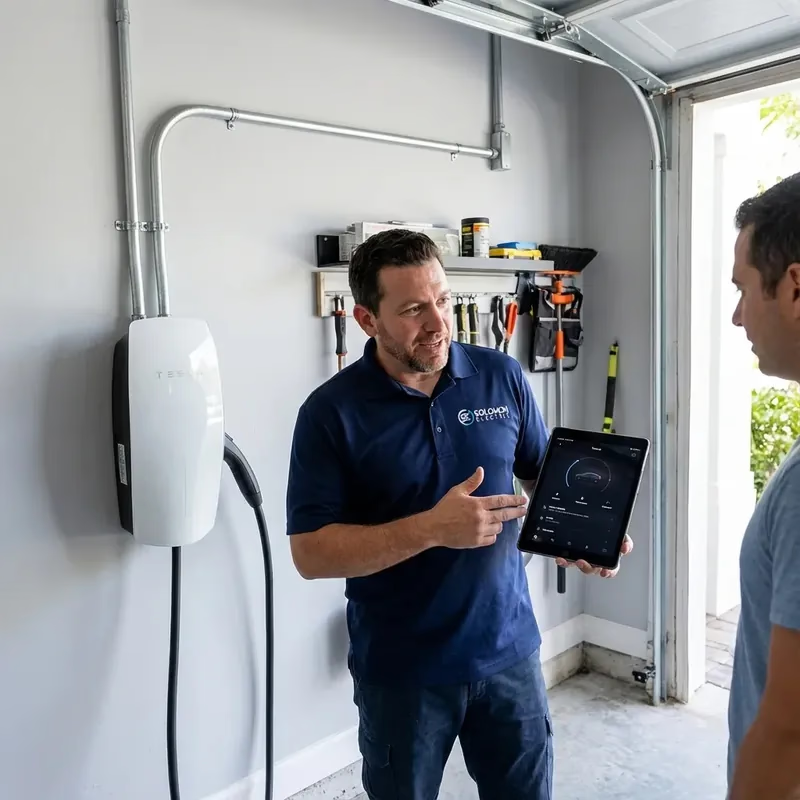
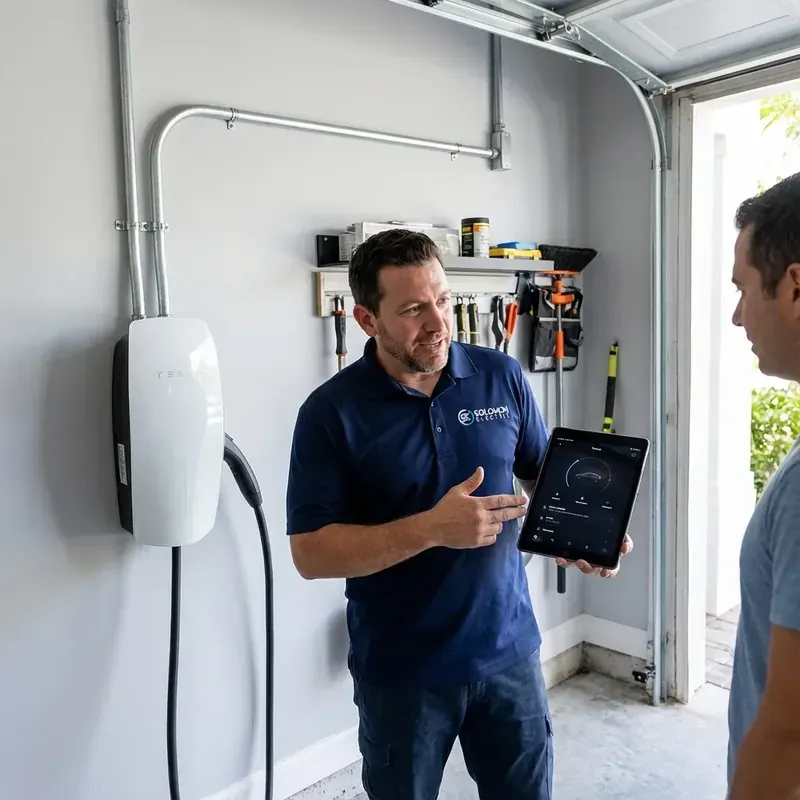
Still charging your EV from a standard 120V outlet? At 4-5 miles of range per hour, Level 1 charging can't keep up with daily driving. Level 2 charging delivers 25-30 miles per hour. Level 2 home charging provides the necessary 240V infrastructure for efficient electric vehicle replenishment. Solomon Electric's licensed team Miami performs professional installation of charging stations including Tesla Wall Connectors and universal J1772 systems, ensuring all circuitry meets high-amperage continuous load standards. Licensed FL electricians installing all major EV charger brands throughout Miami.
How Fast We Work
Most Level 2 charger installations complete within 3-5 hours
Free On-Site Estimate
We provide 100% free, no-obligation on-site estimates for all projects.
Trusted Brands We Install
Tesla Wall Connector, ChargePoint Home Flex, JuiceBox, Grizzl-E
Permits Handled For You
Requires Miami-Dade County electrical permit for new 240V circuit installation
Expert EV Charging & Solar Services in Miami — Home EVSE Setup
Protecting your Miami home starts with recognizing the symptoms of pending electrical failure. Do not ignore these red flags.
Extended Charging Intervals
Standard 120V outlets provide low-amperage charging that may be insufficient for daily transportation requirements in a regional metropolitan area.
HOA and Regulatory Compliance
Condominium and homeowner associations have specific technical and insurance requirements for the installation of electrical equipment in common areas.
Thermal Stress on Receptacles
Standard outlets are not typically rated for high-current loads over multiple hours. Industrial-grade components are required to prevent heat-related failure.
Experiencing any of these issues at your Miami property?
Request Priority InspectionExpert EV Charging & Solar Services in Miami
From emergency dispatches to routine EV Charger Installation, Solomon Electric provides top-tier Level 2 EV Charger Installation directly to Miami residents. Headquartered just 19 miles away, our crews understand local Miami-Dade building nuances and guarantee 100% satisfaction on every project.
- Dedicated high-amperage circuits (40A-60A)
- Specialized installation for condominiums and HOAs
- Municipal permitting and inspection management
- Support for all major EV charging hardware brands
Our Miami Track Record
Florida License #EC13012419
Call Local ElectricianGet Your Free 240V Car Charger Installation Estimate in Miami
Join your neighbors in Miami! Fill out the form and one of our licensed Miami-Dade County electricians will contact you within 30 minutes during business hours. Emergency? Call us 24/7 for immediate dispatch from our hub just 19 miles away.
Licensed & Insured
FL License #EC13012419
4.9 Star Average
1,200++ verified customer reviews
Same-Day Service
Available for Miami and surrounding areas
Request Service
Fast Response Guaranteed
Addressing Miami's Unique Electrical Challenges
South Florida's environment demands specialized electrical knowledge. Our Level 2 EV Charger Installation solutions in Miami are engineered to handle these local factors effectively.
High-Rise Electrical Systems
Miami's skyline requires specialized knowledge of high-voltage distribution, conduit systems, and fire safety codes for multi-story residential and commercial buildings.
Coastal Corrosion & Humidity
Miami's proximity to the Atlantic means salt air and high humidity constantly threaten electrical connections. We use high-grade materials to prevent premature failure.
Historic District Preservation
Neighborhoods like Coconut Grove and Shenandoah feature historic homes with delicate architecture and antiquated wiring that require expert, non-invasive retrofitting.
Expert Compliance Services in Miami
Electrical work in Miami-Dade requires specialized permitting through the RER Department — and dealing with them isn't fun. We take care of every application, coordinate all inspections, and handle the mandatory 40-year recertification checks. You don't touch a single form. We maintain strict compliance with Miami-Dade High Velocity Hurricane Zone (HVHZ) product approvals and stringent local NOA (Notice of Acceptance) permitting guidelines for every Level 2 EV Charger Installation (240V) project in Miami.
Get Your Free Level 2 EV Charger Installation Quote in Miami
Licensed FL #EC13012419 · 1,200++ Reviews · Miami-Dade County
Why Miami Homeowners Trust Us for Electric Vehicle Fast Charging
Local Trust
The #1 EV Charger Installation choice for 450,000+ homeowners throughout the Miami-Dade region.
Rapid Response
Operating locally—we arrive at your Miami property fast, traveling only 19 miles.
Bonded & Insured
We protect your Miami investment with top-tier licensing and $2,000,000 in property coverage.
Code Experts
Passing every inspection. We are masters of the Miami-Dade High Velocity Hurricane Zone (HVHZ) product approvals and stringent local NOA (Notice of Acceptance) permitting guidelines for your region.
Electric Vehicle Fast Charging Benefits for Miami Homeowners
Regulatory Alignment
Professional installation ensures all work meets Florida's specific electrical codes and property insurance requirements for home infrastructure.
Standardized Charging Output
A dedicated Level 2 circuit provides a stable 240V output, aligning with the technical specifications of modern electric vehicle batteries.
System Scalability
Infrastructure can be designed to support dual-charging configurations for properties with multiple electric vehicles.
Environmental Durability
Outdoor components utilize UV-resistant materials and stainless steel hardware to withstand regional Miami and Miami-Dade County weather patterns.
Understanding Miami's Unique
Level 2 EV Charger Installation (240V) Needs
Miami's electrical infrastructure reflects the city's evolution from a small trading post into a global metropolis. Homes in historic neighborhoods like Coconut Grove and Coral Way were built in the 1920s through 1960s, often with knob-and-tube or early Romex wiring systems that were never designed for modern electrical loads. These older systems cannot safely support central air conditioning, multiple kitchen appliances, EV chargers, or home entertainment systems without a complete panel and wiring upgrade.
The Brickell and Downtown corridors present a different challenge: high-rise condominiums with shared electrical systems where individual unit upgrades must be coordinated with building management and city permitting. Our electricians are experienced with the specific requirements of Miami-Dade's Building Department, which maintains some of the strictest electrical codes in the nation due to the region's hurricane exposure and high population density.
Miami's coastal location adds salt air corrosion as a constant threat to outdoor electrical components. Service entrance cables, exterior outlets, landscape lighting connections, and pool equipment wiring degrade faster in Miami than in inland communities. We specify marine-grade hardware and corrosion-resistant enclosures for all exposed installations in the Miami service area.
FPL serves Miami with a combination of overhead and underground distribution, and power quality issues including voltage sags during summer peak demand are common. Whole-home surge protection is not optional in Miami — it is essential infrastructure given the city's position in the lightning corridor and the prevalence of sensitive electronics in modern homes.
Grid & Housing Profile
- Utility Provider
- Florida Power & Light (FPL)
- Avg Home Age
- 45 Years
- Housing Type
- mixed high-rise condos and single-family homes
- Permit Authority
- City of Miami Building Department
Commonly Replaced Panels
In older Miami properties, we frequently replace outdated Federal Pacific, Zinsco, GE panels to meet modern safety codes.
Common 240V Car Charger Installation Questions from Miami Homeowners
What are the rules for condo charging installations in Miami?
How much does Level 2 EV charger installation cost in Miami?
Do I need a dedicated circuit for a Level 2 charger in Miami?
What is the difference between hardwired and plug-in chargers in Miami?
Why do Brickell condos have different electrical requirements than single-family homes?
My Miami home was built in the 1950s—is the wiring still safe?
How Our MiamiTesla Wall Connector Setup Process Works
Electrical Load Analysis
A technician evaluates the property's total electrical footprint to determine the appropriate amperage for the charging station and circuit.
Administrative Documentation
The required technical drawings, insurance certificates, and license verifications are prepared for submission to HOA boards and property management.
Permit Acquisition
Electrical permits are obtained from City of Miami Building Department to ensure the installation is documented and compliant with safety codes.
Structural Wiring
High-gauge copper conductors and dedicated overcurrent protection are installed, followed by a thermal test under operational load.
Equipment Integration
The charging station is mounted and hardwired, followed by a verification of communication between the vehicle and the charging hardware.
Level 1 vs Level 2 EV Charging: Why the Upgrade Matters
Every electric vehicle comes with a Level 1 charger that plugs into a standard 120-volt household outlet. While convenient, Level 1 charging adds only 3-5 miles of range per hour of charging — meaning a full charge for a Tesla Model 3 with a depleted battery takes over 40 hours. For most EV owners, this is simply too slow for daily driving needs.
A Level 2 charger operates on 240 volts (the same voltage as your dryer or oven) and delivers 25-40 miles of range per hour, depending on the charger's amperage and your vehicle's onboard charger capacity. This means a typical daily commute can be fully recovered in 2-3 hours of overnight charging. For families with multiple EVs, a Level 2 charger is not optional — it is essential infrastructure.
The difference in your daily experience is transformative. Instead of anxiously monitoring your battery level, you simply plug in when you get home and wake up to a full charge every morning. It is the EV equivalent of always having a full tank of gas without ever visiting a gas station.
Electrical Requirements for Level 2 EV Charger Installation
Installing a Level 2 EV charger requires a dedicated 240-volt circuit from your electrical panel to the charging location. The circuit size depends on the charger you choose: a 32-amp charger (like the Tesla Wall Connector at its default setting) requires a minimum 40-amp circuit with 8-gauge wire; a 48-amp charger requires a 60-amp circuit with 6-gauge wire; and a 50-amp NEMA 14-50 outlet — the most versatile option — requires a 50-amp circuit.
Before installation, your electrician should perform an NEC load calculation on your existing panel to ensure it has sufficient capacity for the new circuit. Many Miami and Miami-Dade County homes with 100-amp panels may need a panel upgrade to 200 amps before an EV charger can be safely added — especially if the home also has central air conditioning, an electric water heater, and a pool pump.
The installation requires running the appropriate gauge wire from an available breaker space in your panel to the charging location — typically the garage or carport. Wire runs through attics in Florida's heat must use wire rated for high-temperature environments. The charger must be installed on a dedicated circuit (no other loads) with appropriate overcurrent protection.
Hardwired vs Plug-In EV Chargers: Which is Right for You
EV chargers come in two installation configurations: hardwired (permanently connected to the circuit) and plug-in (connected via a NEMA 14-50 or 6-50 outlet). Each has advantages depending on your situation.
Hardwired chargers are permanently mounted and wired directly into your electrical system. They typically support higher amperage (up to 60 amps for 48-amp continuous charging), look cleaner with no visible cord or outlet, and are the preferred option for permanent installations. The downside: if you move, you leave the charger behind or need an electrician to disconnect it.
Plug-in chargers connect to a NEMA 14-50 outlet — the same type used by most electric ranges and RVs. The advantage is portability: you can take the charger with you if you move, and the outlet serves as a versatile 240-volt connection for other purposes. The limitation is that most plug-in chargers are capped at 40 amps (32-amp continuous draw) due to the NEMA 14-50 outlet's rating.
For most homeowners planning to stay in their home long-term, we recommend a hardwired installation with a 60-amp circuit. This provides maximum charging speed and a clean, professional appearance. For renters or those planning to move within a few years, a NEMA 14-50 outlet provides flexibility.
EV Charger Incentives and Rebates Available in Florida
The federal government currently offers a tax credit of up to 30% of the cost of purchasing and installing a home EV charger, up to a maximum allowable credit, through the Alternative Fuel Vehicle Refueling Property Credit (IRS Form 8911). This credit applies to the cost of the charger itself as well as the installation labor.
Florida Power & Light (FPL) (Florida Power & Light) periodically offers rebate programs for residential EV charger installations, though these programs have limited funding windows. Check FPL's current incentive offerings before scheduling your installation — timing your project to coincide with an open rebate window can save significantly.
Some municipalities in Miami and Miami-Dade County offer additional incentives, expedited permitting, or reduced permit fees for EV charger installations as part of their sustainability initiatives. Miami-Dade County's Office of Resilience, for example, has supported EV infrastructure initiatives. Your electrician should be familiar with current local incentives and can advise on timing your installation for maximum savings.
Serving All Miami Neighborhoods
Our technicians are active throughout Miami, providing 240V Car Charger Installation to residential and commercial properties. Whether you're in Brickell or The Roads, we understand the mixed high-rise condos and single-family homes building stock and Miami-Dade County requirements of your specific community.
Local Area Map
We provide expert electrical services near major Miami landmarks, ensuring efficient response times for all local homeowners and business owners.
Verified Local Provider
Full coverage for Miami and surrounding communities in Miami-Dade County.
Other Electrical Services in Miami
Schedule Your Free Level 2 EV Charger Installation Estimate in Miami
Get expert electrical service from Miami's most trusted electricians. Licensed, insured, and available 24/7 for your electrical needs in Miami-Dade County.
Request Service
Fast Response Guaranteed
Related Articles
Learn more about EV Charger Installation from our expert guides
Related Local Searches for Miami
- Level 2 EV Charger Installation in Miami
- Tesla Wall Connector Setup in Miami
- Electric Vehicle Fast Charging in Miami
- 240V Car Charger Installation in Miami
- Home EVSE Setup in Miami
Level 2 EV Charger Installation Near Miami
Solomon Electric provides expert level 2 ev charger installation across Miami-Dade County. Browse our service coverage in these neighboring communities.