When Your Kitchen Needs More Power
You’re renovating your Miami kitchen. Out goes the builder-grade gas range. In comes a sleek induction cooktop, double wall ovens, and a commercial-grade refrigerator.
Your electrician breaks the news: Your 100-amp panel can’t handle it.
Modern kitchens are power-hungry. Between high-wattage appliances, task lighting, and specialty equipment, today’s kitchens often draw more power than entire 1970s homes. Here’s how to wire them safely and to code.
Quick Answers: Kitchen Wiring FAQ
What size circuit does my electric range need?
Most electric ranges require 40-50 amp 240V circuits with 6 AWG or 8 AWG copper wire. The exact requirement depends on the range’s power rating:
- Standard ranges: 40 amps (8 AWG wire)
- High-power/double-oven ranges: 50 amps (6 AWG wire)
- Commercial-style ranges: Sometimes 60 amps (4 AWG wire)
We size circuits based on manufacturer specifications and NEC requirements—never guess.
Can I plug a new range into my old outlet?
Only if the outlet matches the range’s plug configuration. Ranges come with either:
- 3-prong plugs: Older standard (hot-hot-neutral)
- 4-prong plugs: Modern standard (hot-hot-neutral-ground)
Most new ranges come with 4-prong plugs. If your house has a 3-prong outlet, we upgrade to 4-prong for safety (separate ground wire).
How much does it cost to add a 240V circuit for a kitchen appliance?
Cost varies based on:
- Distance from panel to appliance location
- Wire routing difficulty (through walls, attic, crawl space)
- Need for drywall repair
- Type of circuit (30A, 40A, 50A)
- Panel capacity (does panel need upgrade?)
We provide upfront estimates after assessing your specific situation.
Common Kitchen Appliance Wiring Requirements
Electric Ranges & Ovens
Circuit requirements:
- Voltage: 240V
- Amperage: 40-50 amps (some commercial units require 60A)
- Wire gauge: 6 AWG or 8 AWG copper (depends on amp rating and distance)
- Breaker: Double-pole breaker (both hot wires on same handle)
- Outlet: NEMA 14-50 (50A, 4-prong) most common
Installation process:
- Calculate exact amperage requirement from range specs
- Install appropriate double-pole breaker in panel
- Run proper gauge wire from panel to range location
- Install 4-prong outlet (NEMA 14-50 or hard-wire)
- Test voltage, polarity, and ground
- Connect and test range
Induction & Electric Cooktops
Why induction cooktops are popular in Miami:
- More energy-efficient than gas or standard electric
- Faster heating (water boils in half the time)
- Cooler kitchen (less heat output)
- Precise temperature control
Circuit requirements:
- 30-inch cooktops: Typically 30-40 amps
- 36-inch+ cooktops: Often 40-50 amps
- Commercial induction: Can exceed 50 amps
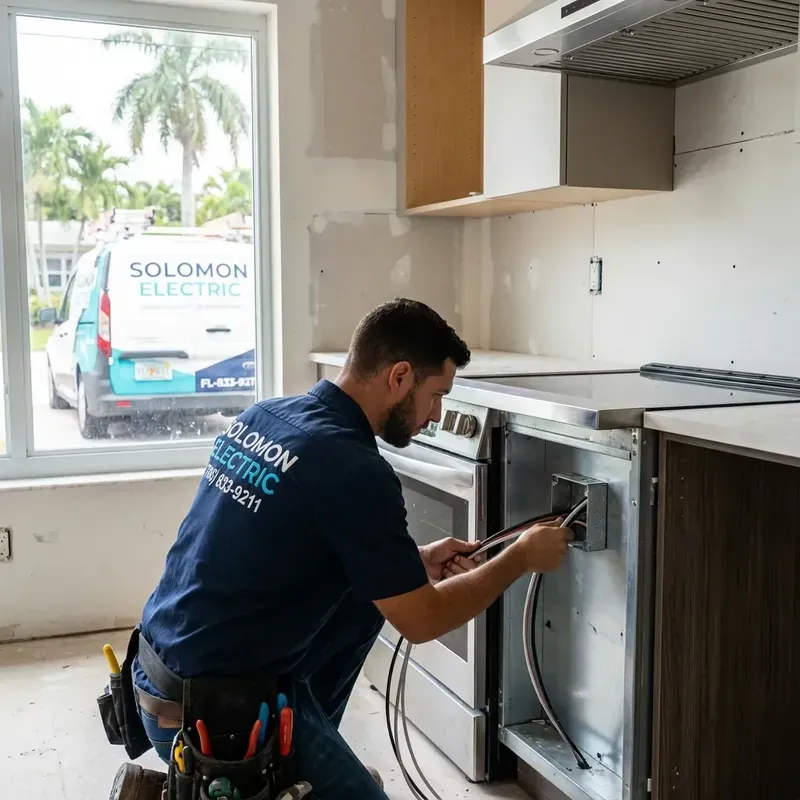
Hard-wire vs. plug-in: Most cooktops are hardwired directly (no outlet). We install junction box behind/below unit for connection.
Wall Ovens
Single wall ovens:
- 30-40 amp circuits
- Often hardwired
- Can share circuit with cooktop if combined load allows
Double wall ovens:
- 40-50 amp circuits
- Always dedicated circuit
- Higher power consumption than single ovens
Dishwashers
Circuit requirements:
- Voltage: 120V
- Amperage: 15-20 amps
- Dedicated circuit: Required by code
- GFCI protection: Not typically required (hard-wired appliance)
Installation location: Under sink area or adjacent cabinet with hardwired connection.
Garbage Disposals
Circuit requirements:
- Voltage: 120V
- Amperage: 15-20 amps
- Dedicated circuit: Recommended (often shares with dishwasher)
- GFCI: Code requires GFCI protection
- Switch: Wall switch above counter required
Microwaves
Built-in/over-range microwaves:
- 120V, 15-20 amp dedicated circuit
- Some high-power models need 20A
- Often hardwired behind unit
Countertop microwaves:
- Plug into standard 120V outlet
- Don’t need dedicated circuit
Specialty & Commercial Equipment
Commercial-Grade Ranges
Wolf, Viking, BlueStar commercial-style ranges:
- Often require 50-60 amp circuits
- May need special ventilation electrical (hood fans)
- Higher BTU ratings demand more power
- Sometimes require dual fuel (gas + electric)
Dual fuel electrical requirements: Electric oven portion still needs 240V circuit even if cooktop is gas.
Wine Refrigerators & Beverage Centers
Dedicated circuits recommended:
- Prevent power interruptions from other appliances
- 120V 15-20 amp circuits
- Temperature-sensitive storage benefits from circuit stability
Espresso Machines & Coffee Makers
High-end built-in coffee systems:
- 120V or 240V depending on model
- 15-20 amp dedicated circuits
- Often hardwired behind cabinetry
Warming Drawers
Circuit requirements:
- 120V or 240V (model-dependent)
- 15-20 amps
- Can share circuit with wall oven circuit if load allows
- Often hardwired
Kitchen Renovation Electrical Considerations
Panel Capacity Planning
Typical modern Miami kitchen electrical load:
- Electric range: 40-50 amps (240V)
- Cooktop: 30-40 amps (240V)
- Wall oven(s): 30-50 amps (240V)
- Dishwasher: 15 amps (120V)
- Disposal: 15 amps (120V)
- Refrigerator: 15-20 amps (120V)
- Microwave: 15-20 amps (120V)
- Small appliance circuits: 40 amps total (two 20A circuits)
- Lighting: 15 amps
Total: 200+ amps of circuits (though not all run simultaneously)
Many 100-amp panels can’t support modern kitchens. We often recommend 200-amp panel upgrades during major kitchen renovations.
Small Appliance Circuits
Code requires: Two 20-amp 120V circuits serving countertop outlets for small appliances (toasters, blenders, mixers, etc.).
These circuits cannot serve:
- Refrigerator
- Dishwasher
- Disposal
- Microwave
- Lighting
GFCI Requirements
GFCI protection required in kitchens:
- All countertop outlets within 6 feet of sink
- All countertop outlets serving counter surfaces
GFCI not typically used for:
- Refrigerator (nuisance tripping concerns)
- Dishwasher (hardwired appliance)
- Disposal (hardwired appliance)
- Hood fan
Code Compliance for Miami Kitchens
Outlet Spacing Requirements
Code requires:
- Outlet every 4 feet along counter
- No point on counter more than 2 feet from outlet
- Island/peninsula counters 12+ inches need at least one outlet
Dedicated Circuit Requirements
Must have dedicated circuits:
- Refrigerator
- Dishwasher
- Disposal (can share with dishwasher if load allows)
- Microwave (built-in)
- Electric range/cooktop
- Wall ovens
Grounding Requirements
All kitchen circuits must be grounded properly:
- Three-wire circuits minimum (hot, neutral, ground)
- Metal boxes must be bonded to ground
- GFCI outlets provide shock protection even without ground (labeled accordingly)
Permit Requirements
Permits required for:
- Adding new circuits
- Upgrading electrical panel
- Moving outlets or switches
- Adding 240V circuits
We handle all permitting and coordinate inspections.
Professional Kitchen Electrical Installation
Serving Miami home chefs and commercial kitchens throughout Miami-Dade and Broward counties.
Planning a Kitchen Renovation?
We design and install electrical systems for modern, power-hungry kitchens.
Schedule Kitchen Electrical Consultation